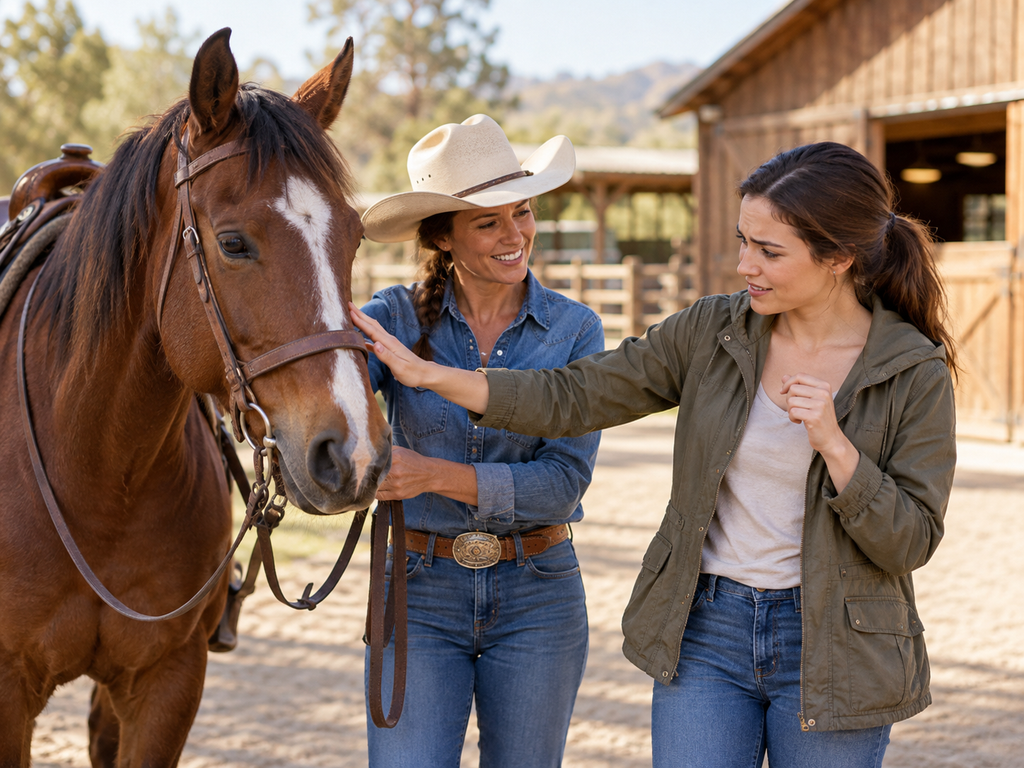
A California ranch vacation for beginners should offer more than a beautiful trail photo. Look for an orientation, a riding pace that matches your experience, a clear horse-matching process, and worthwhile activities if you sit out a ride. Ask the ranch about its actual program on your dates before you book. This simple check makes the trip easier for both new riders and the people traveling with them.
Decide what kind of riding day you want
California ranch stays cover different landscapes and styles of travel. A forest outing, a ride through oak-covered hills, and an active cattle ranch may demand different skills and energy. Visit California’s overview of ranch experiences illustrates that range; individual properties combine riding with other activities in different ways.
Start by choosing between an introduction to riding and a trip built around long hours in the saddle. If you have never ridden, say so plainly. Ask whether a wrangler gives a ground briefing, whether lessons or arena practice precede trail rides, and how the group is divided by ability. Also ask if a guest can choose a shorter ride or rest day without missing the heart of the vacation.
Ask specific questions about the horse program
“Beginners welcome” is a useful starting point, but it does not describe the whole day. A short call can clarify what happens after breakfast: how many rides are offered, their approximate duration, their usual pace, and who leads them. Find out whether the ranch asks about age, height, weight, mobility, and riding history when assigning horses. State any concern before arriving, including fear of heights or difficulty mounting.
Equipment matters too. Confirm helmet and boot policies and whether the ranch supplies either item. A rider who has taken one lesson and a rider who rides weekly may both be called “beginners” in casual conversation; give the property a precise picture of your experience. Follow the staff’s instructions once on site, and do not assume that a faster group is the better group.
Ask the ranch
Why the answer helps
Is there an orientation or first-day lesson?
Sets realistic expectations for a new rider.
How are horses and ride groups matched?
Shows how the program handles different abilities.
Can I skip or shorten a ride?
Helps a mixed-interest group plan its days.
What is included in the quoted rate?
Prevents surprises about meals and activities.
Match a California ranch vacation to your group
If one guest loves horses and another prefers fishing, walking, or relaxed meals, compare the actual schedules rather than assuming every ranch offers all of them. The RanchWeb California horseback riding ranch vacations page is a starting point for looking across California properties; check each listing and the ranch directly for its current offerings. You can also browse Ranchweb horseback riding vacations to see how ranch types differ before narrowing the destination.
Ask when the ranch is open and what conditions are typical during your travel window. A shoulder-season bargain is less attractive if your group expected a particular activity that is unavailable then. For families, ask about age limits for riding, supervision, and whether children’s and adults’ programs meet during the day. For adults, ask whether non-riding companions can take part in meals and excursions together.
Compare the total trip, then confirm directly
Make a shortlist of two or three ranches and write down the same answers for each: ride frequency, group size policy, lesson availability, included meals, other activities, and travel time from your arrival point. The cheapest nightly rate may not be the best fit if the riding program or stay length differs. Before paying a deposit, check cancellation terms and any minimum stay with the property.
Conclusion
The right first ranch trip gives new riders a way to learn at a comfortable pace and gives the rest of the group a good vacation too. Ask detailed questions, choose a landscape and season you will enjoy, and let the ranch describe what it can provide on your specific dates.
Frequently Asked Questions
Do I need riding lessons before booking a California ranch?
Not necessarily. Ask whether the property takes complete beginners, provides orientation or instruction, and has a suitable first ride. A lesson beforehand can build confidence, but it does not replace the ranch’s own briefing.
Can experienced riders travel with beginners?
Often, but the ranch may use separate rides or ability groups. Ask how schedules overlap so the group can plan shared time before and after riding.
What if I decide not to ride one day?
Ask about non-riding activities and whether you can join the group for meals or outings. Options vary by property and season.
Is a working cattle ranch suitable for a first-time rider?
It depends on the ranch’s guest program and the work planned during your stay. Describe your experience and ask whether introductory rides are offered before considering ranch work.
When should I check the activity schedule?
Before booking and again shortly before travel. Availability, weather, staffing, and seasonal operations can affect the activities offered on particular dates.
Training a horse is not simply about teaching commands or getting a horse to accept a rider. Good horse training develops communication, physical readiness, confidence, manners, and trust between horse and handler.
The strongest training programs usually begin with simple foundations on the ground before progressing toward more demanding ridden work. They also recognize that behavior, health, equipment, fitness, and environment are connected. When one of these areas is overlooked, what appears to be a training problem may actually have another cause.
Whether you are beginning with a young horse, retraining an experienced horse, or simply improving everyday manners, a structured and patient approach can make training safer and more productive.
1. Make Sure the Horse Is Ready to Learn
Before beginning a training session, assess the horse rather than immediately asking it to work.
Observe how the horse:
Walks and stands
Responds to your presence
Eats and drinks
Moves through turns
Reacts when groomed
Responds when its feet are handled
Behaves during saddling or bridling
Changes in behavior can sometimes have physical causes.
For example, a horse that suddenly becomes unwilling to move forward, pins its ears when saddled, bucks, refuses particular movements, or becomes unusually difficult should not automatically be labeled stubborn.
Pain, poor saddle fit, hoof discomfort, dental problems, fatigue, illness, or an unsuitable workload can influence behavior.
The University of Minnesota Extension notes that bucking under saddle can sometimes result from problems such as back discomfort, inappropriate saddle fit, rider imbalance, or frustration. Physical discomfort should therefore be considered before treating every unwanted response purely as a behavioral problem.
That is why training should work alongside a complete horse care program rather than being viewed as a separate activity.
2. Establish Basic Ground Manners First
Before asking a horse to perform advanced exercises, establish a few reliable behaviors.
A horse should gradually learn to:
Walk calmly beside the handler
Stop when requested
Back several controlled steps
Stand quietly
Yield its hindquarters
Move its shoulders when asked
Respect the handler’s space
Allow its feet and body to be handled
These behaviors make everyday management safer and create the foundation for more complex exercises.
The goal is not to dominate the horse. Instead, the goal is to establish predictable communication.
When the handler provides the same cue in a consistent way and releases or rewards at the appropriate moment, the horse has a better opportunity to understand what is being requested.
3. Use Groundwork to Develop Communication
Groundwork is one of the most useful stages between basic handling and ridden training.
It allows a handler to work on communication while observing the horse’s movement from the ground.
Exercises can include:
Leading and Halting
Practice walking forward, stopping, and changing direction without the horse dragging behind or rushing ahead.
Aim for calm responsiveness rather than speed.
Backing
Ask for one controlled backward step before gradually requesting additional steps.
Backing can help reinforce attention to the handler and improve control of the horse’s feet.
Yielding the Hindquarters
Teach the horse to move the hindquarters away from an appropriate cue.
This can become valuable during handling and later ridden work because it teaches the horse to move individual parts of its body rather than always moving as one unit.
Moving the Shoulders
Once hindquarter control improves, the handler can introduce exercises involving the shoulders.
Again, begin with small responses rather than demanding several perfect steps immediately.
Obstacle Exercises
Poles, cones and other safe objects can make groundwork more varied while helping horses become comfortable with new situations.
The objective should not be to deliberately frighten the horse. Introduce unfamiliar objects gradually and allow the horse to investigate them.
One of the most important concepts in horse training is timing.
Many horse-training exercises involve some form of cue or controlled pressure. The horse needs to understand not only when pressure begins but also which response causes it to end.
Imagine asking a horse to step backward.
You provide a clear cue. The horse considers several possible responses. The moment it attempts the correct backward movement, you soften or release the cue.
That release helps communicate:
“That was the response I wanted.”
Poor timing can make otherwise simple exercises confusing.
If the pressure continues after the correct response, the horse may struggle to determine what behavior earned the release.
Similarly, immediately demanding several perfect steps from a horse that is just learning may create unnecessary frustration.
Initially, reward an honest attempt. Refine the response as understanding improves.
5. Keep Training Sessions Purposeful
Longer training sessions are not automatically better.
A productive 15-minute session can sometimes accomplish more than an unfocused hour.
Before beginning, decide what you want to improve.
For example:
Today’s goal: Calm transitions between walking and stopping.
This creates a clearer training session than trying to improve leading, backing, lunging, saddling, obstacles, loading, and ridden work simultaneously.
Introduce new tasks gradually while occasionally returning to something the horse already performs well.
This can maintain confidence and prevent every training session from becoming a constant series of difficult challenges.
Training also does not progress perfectly every day.
A horse may perform an exercise successfully several times and later struggle with it. Environment, energy level, distractions, fitness, discomfort, and previous experiences can influence performance.
Evaluate patterns rather than becoming frustrated by one imperfect session.
6. Develop Fitness Gradually
Mental understanding does not necessarily mean physical readiness.
A horse may understand what is being requested but lack sufficient conditioning to perform an exercise repeatedly or correctly.
Muscles, tendons, ligaments, cardiovascular fitness, coordination, and balance develop through progressive conditioning.
Avoid suddenly increasing:
Training duration
Speed
Jump height
Hill work
Repetitions
Distance
Intensity
The American Association of Equine Practitioners emphasizes the importance of appropriate exercise for horses and recommends veterinary guidance when determining individual exercise needs and returning horses to fitness after periods of reduced work.
Rest and recovery are part of training as well.
A horse repeatedly worked while physically exhausted is unlikely to produce its best movement or learning.
7. Check Hooves and Footing
Training begins at ground level—literally.
Hoof condition and the surface on which the horse works can influence movement, comfort, confidence, and safety.
Before working, check for obvious problems such as:
Loose or damaged shoes
Stones caught around the hoof
Cracks
Unusual heat
Tenderness
Debris packed into the hoof
The training surface also matters.
Very deep, excessively hard, slippery, rocky, or uneven footing can increase difficulty and may affect how willingly a horse performs certain movements.
Use a surface appropriate for the exercise whenever possible.
8. Introduce Tack Carefully
Once groundwork is established and the horse is ready to progress, equipment becomes another important part of training.
Introduce tack systematically.
Depending on the horse’s experience, this may involve becoming comfortable with:
A halter and lead
Grooming around the girth area
A saddle pad
The saddle
The girth
A bridle
Movement while wearing equipment
Mounting preparation
Do not rush simply because the horse accepts an item once.
Observe its body language and movement.
The saddle deserves particular attention because incorrect fit may create discomfort and interfere with performance.
Horse training is not exclusively about training the horse.
The rider’s balance, timing, confidence, hands, seat, and use of cues can influence how easily the horse understands an exercise.
An inconsistent rider can unintentionally give contradictory signals.
For example, asking a horse to move forward with the legs while simultaneously restricting forward movement heavily through the reins may create confusion.
Riders should continue developing their own skills through appropriate instruction.
Safety equipment is equally important.
A properly fitted equestrian helmet, suitable riding footwear, and clothing that allows unrestricted movement should form part of responsible riding preparation.
Our Riding Apparel guide covers essential clothing and protective equipment for riders.
10. Learn to Recognize Stress and Confusion
Not every resistance is deliberate disobedience.
Watch the horse’s whole body.
Possible indications of tension or confusion may include:
Repeated tail swishing
Rushing
Freezing
Excessive head movement
Continually attempting to escape an exercise
Unusual ear position
Difficulty concentrating
Repeatedly performing the wrong response
Sudden behavioral changes
Context matters.
One isolated behavior does not necessarily indicate a problem. However, repeated patterns deserve investigation.
Ask yourself:
Does the horse understand the cue?
Is the exercise physically comfortable?
Am I asking too much too quickly?
Is my timing clear?
Is the equipment appropriate?
Has something changed physically or environmentally?
Sometimes the best training decision is to simplify the exercise.
11. Know When to Get Professional Help
Horse owners should recognize the limits of their experience.
Professional assistance is particularly important when dealing with dangerous behaviors such as severe rearing, bolting, aggressive biting, striking, persistent bucking, or other situations where horse and handler could be injured.
Depending on the situation, help might come from:
An experienced horse trainer
Riding instructor
Veterinarian
Farrier
Equine dentist
Qualified saddle fitter
Good horsemanship includes knowing when a problem requires another area of expertise.
A trainer cannot diagnose every physical problem, just as a veterinarian is not automatically responsible for correcting every training issue.
The best results often come from considering the entire horse.
Training Should Create a More Confident Horse
Successful horse training is not measured only by how many movements a horse can perform.
A well-developed training program should gradually produce a horse that is more attentive, comfortable, responsive, manageable, and confident.
Build the basics first.
Establish good ground manners. Develop communication through groundwork. Progress according to the horse’s understanding and fitness. Use appropriately fitted equipment. Pay attention to health and comfort. And remember that riders must continue learning too.
Horse training is a continuing process rather than a finish line.
That philosophy is central to Never Done Farm: there is always another opportunity to improve our understanding of horses, their care, and the partnership we build with them.
Explore more horse training, care, riding, and equestrian resources on the Never Done Farm homepage.